New treatment for pyridoxine-dependent epilepsy due to ALDH7A1 deficiency: first proof-of-principle of upstream enzyme inhibition in the mouse
Jan 1, 2025·,,,,,,,,,, ,·
0 min read
,·
0 min read
Clara D. M. Van Karnebeek
Valérie Gailus-Durner
Udo F. Engelke
Claudia Seisenberger
Susan Marschall
Nathalia R. v. Dragano
Patricia Da Silva-Buttkus
Stefanie Leuchtenberger
Helmut Fuchs
Martin Hrabě De Angelis
Ron A. Wevers
Curtis Coughlin II
Dirk J. Lefeber
Abstract
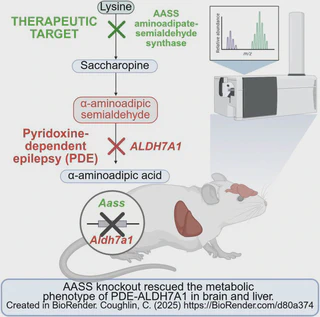
Pyridoxine-dependent epilepsy (PDE) due to recessive ALDH7A1 mutations is characterized by intractable epilepsy that is often unresponsive to antiseizure medications. Irrespective of pyridoxine (vitamin B6) supplementation and lysine reduction therapy, patients present severe residual neurocognitive deficits. We evaluated upstream inhibition of 2-aminoadipic semialdehyde synthase (AASS) as a novel therapeutic strategy to reduce the accumulating metabolites (α-aminoadipic semialdehyde, Δ1-piperideine-6-carboxylate, pipecolic acid, 6-oxo-pipecolic acid and 2S,6S-/2s,6R-oxopropylpiperidine-2-carboxylic acid) considered neurotoxic. We utilized an existing mouse knockout model of hyperlysinaemia (Aass-knockout) and generated a PDE model, a Aldh7a1 single knockout model via CRISPR/Cas (clustered regularly interspaced short palindromic repeats and CRISPR-associated protein) and generated the double-knockout Aass/Aldh7a1 mice. Next-generation metabolomics screening was performed to measure all known biomarkers in brain, liver and plasma of wild-type and mutant mice. Metabolomics confirmed the known metabolite markers for Aldh7a1-knockout and Aass knockout mice in all samples. The potentially neurotoxic metabolites (Δ1-piperideine-6-carboxylate, pipecolic acid, 6-oxo-pipecolic acid and 2S,6S-/2s,6R-oxopropylpiperidine-2-carboxylic acid) significantly decreased in double-knockout Aass/Aldh7a1 mice brain and liver tissues compared to Aldh7a1-knockout mice. Plasma analysis revealed a significant reduction of known biomarkers, suggesting a reliable monitoring option in human patients. We demonstrate the first mammalian evidence that AASS inhibition is a viable strategy to rescue abnormal brain metabolism associated with PDE. This may target the intellectual disability and neurologic deficits caused by persistent lysine catabolic-related neurotoxicity despite adequate vitamin B6 supplementation.
Type
Publication
Brain Commun. Oct 14;7(6):fcaf397
2-Aminoadipic Semialdehyde Synthase Inhibition
Lysine Biochemistry
Metabolic Epilepsy
Mouse Model
Therapy

Authors
Associate Professor
Translational researcher focused on rare diseases and bioethics