Assessment of urinary 6-oxo-pipecolic acid as a biomarker for ALDH7A1 deficiency
Jan 1, 2025·,,, ,,,,,·
0 min read
,,,,,·
0 min read
Youssef Khalil
Emma Footitt
Reddy Vootukuri
Michael F. Wempe
Curtis Coughlin II
Spyros Batzios
Matthew P. Wilson
Viktor Kožich
Peter T. Clayton
Philippa B. Mills
Abstract
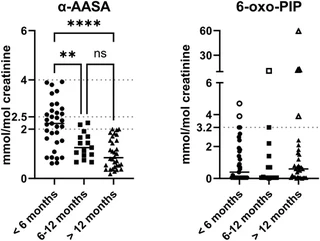
ALDH7A1 deficiency is an epileptic encephalopathy whose seizures respond to treatment with supraphysiological doses of pyridoxine. It arises as a result of damaging variants in ALDH7A1, a gene in the lysine catabolism pathway. α-Aminoadipic semialdehyde (α-AASA) and Δ1-piperideine-6-carboxylate (P6C), which accumulate because of the block in the lysine pathway, are diagnostic biomarkers for this disorder. Recently, it has been reported that 6-oxo-pipecolic acid (6-oxo-PIP) also accumulates in the urine, CSF and plasma of ALDH7A1-deficient individuals and that, given its improved stability, it may be a more suitable biomarker for this disorder. This study measured 6-oxo-PIP in urine from a cohort of 30 patients where α-AASA was elevated and showed that it was above the normal range in all those above 6 months of age. However, 6-oxo-PIP levels were within the normal range in 33% of the patients below 6 months of age. Levels increased with age and correlated with a decrease in α-AASA levels. Longitudinal analysis of urine samples from ALDH7A1-deficient patients who were on a lysine restricted diet whilst receiving supraphysiological doses of pyridoxine showed that levels of 6-oxo-PIP remained elevated whilst α-AASA decreased. Similar to α-AASA, we found that elevated urinary excretion of 6-oxo-PIP can also occur in individuals with molybdenum cofactor deficiency. This study demonstrates that urinary 6-oxo-PIP may not be a suitable biomarker for ALDH7A1 deficiency in neonates. However, further studies are needed to understand the biochemistry leading to its accumulation and its potential long-term side effects.
Type
Publication
J Inherit Metab Dis. Jan;48(1):e12783
2-Aminoadipic Acid
6‐oxo‐pipecolic Acid
Aldehyde Dehydrogenase
Mitochondrial
ALDH7A1 Deficiency
Aminoadipic Semialdehyde
Biomarkers
Child
Preschool
Epilepsy
Female
Humans
Infant
Newborn
Lysine
Male
Pipecolic Acids
Piperideine‐6‐carboxylate
Pyridoxine
Pyridoxine‐dependent Epilepsy

Authors
Associate Professor
Translational researcher focused on rare diseases and bioethics